
In order to get a better understanding of how I could produce the stories created on a digital format, I researched the topic of digital storytelling, what it is and how to use it in the most effective way possible for my project.
Digital storytelling describes a simple process through which people with little experience of computers gain skills needed to tell a personal story as a two-minute film using predominantly still images. These films can then be streamed on the web or broadcast on television. A digital storyteller can be anyone who has a desire to document life experience, ideas, or feelings through the use of story and digital media. Usually someone with little experience in video production but with time to spend a few days attending a workshop and developing a story with creative support and technical assistance from experienced facilitators.
The term “digital storytelling” can also cover a range of digital narratives (web-based stories, interactive stories, hypertexts, and narrative computer games). It is sometimes used to refer to film-making in general, and as of late, it has been used to describe advertising and promotion efforts by commercial and non-profit enterprises.
The most important characteristics of a digital story are that it no longer conforms to the traditional conventions of storytelling because it is capable of combining still imagery, moving imagery, sound, and text, as well as being nonlinear and contain interactive features. The expressive capabilities of technology offers a broad base from which to integrate. It enhances the experience for both the author and audience and allows for greater interactivity.
With media devices like computers, digital cameras, recorders, and software, individuals may share their digital stories via the Internet or podcasts, or other electronic media. Digital storytelling combines the art of storytelling with multimedia features such as photography, text, audio, voiceover, hypertext and video. Digital tools and software like iMovie and Movie Maker make it easy and convenient to create a digital story.
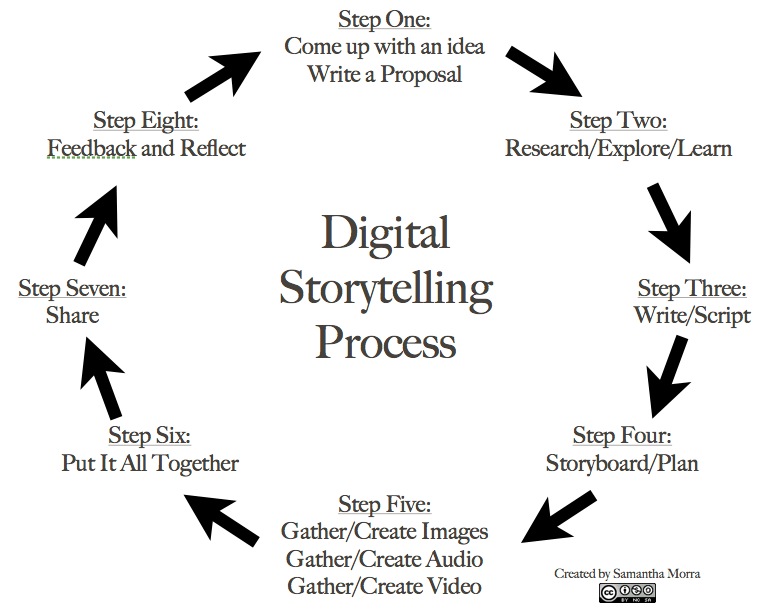
For the purposes of my project however, the individuals involved in helping create the story will have no part in the actual production of the final product and by this I mean, I will be the one adding the audio and visual elements and doing the final edit. Those involved will just be creating the actual story used. The other difference with my project is that, i am moving in the direction of a fictional story rather than personal stories which the topic of Digital storytelling revolves around. I hope to create a process that will help the user to write and upload the story but will be doing the final production without their help. So if we use the image above as a rough guide the users will be involved during step three but I will continue the process without them.
References:
- Arts.brighton.ac.uk. (2018). What is “digital storytelling?” – Silver Stories. [online] Available at: http://arts.brighton.ac.uk/projects/silver-stories/how-can-we-understand-digital-storytelling [Accessed 5 Aug. 2018].
- S3.amazonaws.com. (2018). [online] Available at: https://s3.amazonaws.com/academia.edu.documents/7401742/digitalstorytelling.pdf?AWSAccessKeyId=AKIAIWOWYYGZ2Y53UL3A&Expires=1535368523&Signature=hEsuMh7r7TkCLjtA3jV0p79jHuU%3D&response-content-disposition=inline%3B%20filename%3DDigital_storytelling_a_meaningful_techno.pdf [Accessed 5 Aug. 2018].
- Opencourses.uoa.gr. (2018). [online] Available at: http://opencourses.uoa.gr/modules/document/file.php/ENL10/Instructional%20Package/PDFs/Unit3a_Digital_storytelling.pdf [Accessed 5 Aug. 2018].
- Digitalstorytelling.coe.uh.edu. (2018). Educational Uses of Digital Storytelling. [online] Available at: http://digitalstorytelling.coe.uh.edu/page.cfm?id=27&cid=27&sublinkid=31 [Accessed 5 Aug. 2018].

 Direction concepts