In order to get an idea what what might take place during each Act I did some research on Propp’s Morphology of the Folk Tale. Vladimir Propp was a Soviet folklorist and scholar who analysed the basic plot components of Russian folk tales to identify their simplest narrative elements. He broke down the stories into morphemes (sections of the stories can could be analysed) and identified 31 narratemes (narrative units) that comprised the structure of many of the stories.
He identified that “Five categories of elements define not only the construction of a tale, but the tale as a whole.”:
- Functions of the characters
- Conjunctive elements (ex machina, announcement of misfortune, chance disclosure – mother calls hero loudly, etc.)
- Motivations (reasons and aims of a character/s)
- Forms of appearance of characters (the flying arrival of dragon, chance meeting with donor)
- Attributive elements or accessories (witch’s hut or her clay leg)
” Whilst not all stories will contain all of Propp’s narratemes, it is surprising to find stories that contain none, and many modern books and movies fit nicely into his categories.”
He categorised these stories into four spheres
- 1st sphere: Introduction
- 2nd sphere: The body of the body of the story
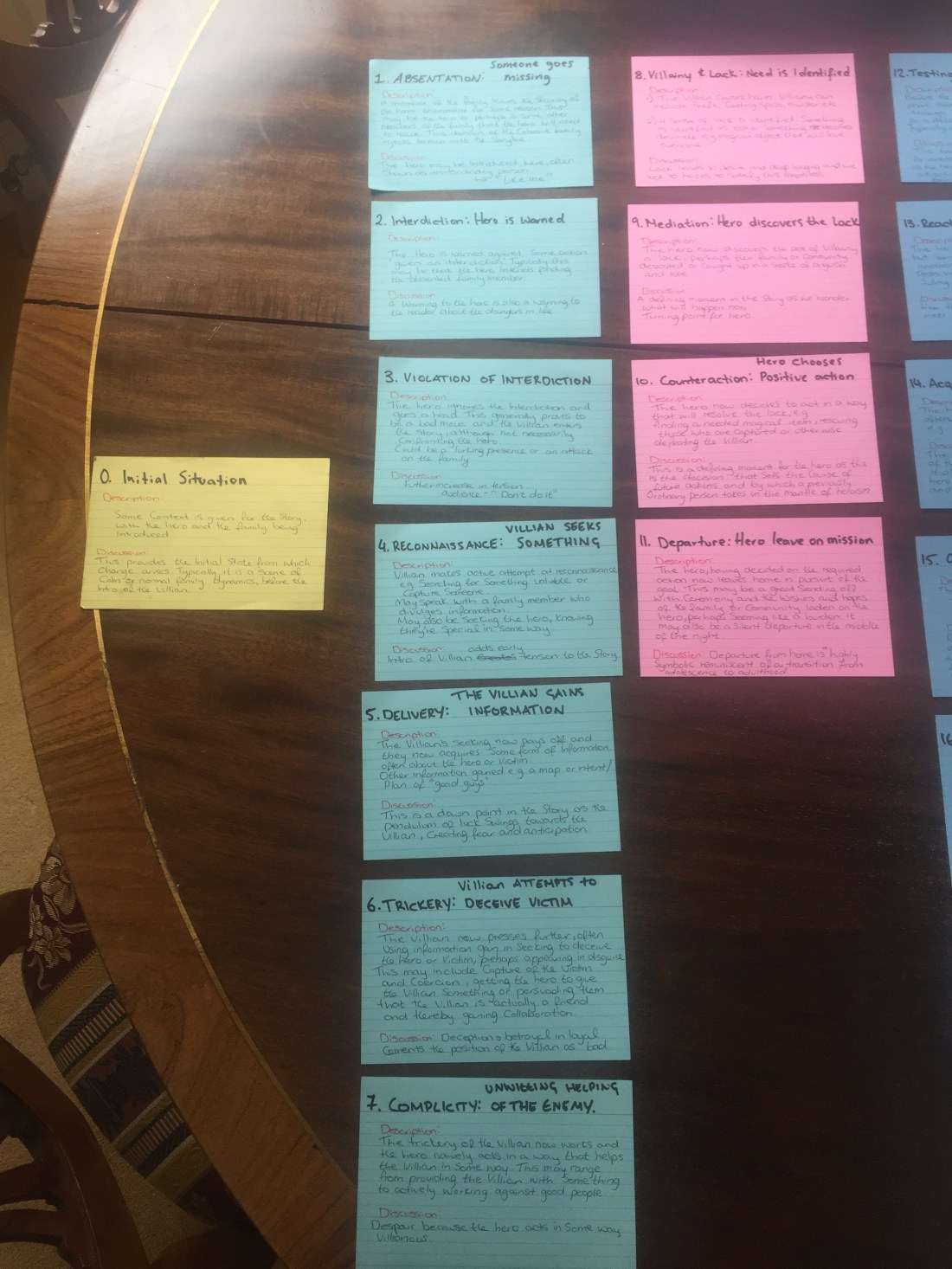
The cards in blue are the seven narratemes of the first sphere, the pink cards are the four narratemes of the second sphere
- 3rd sphere: The donor sequence
- 4th sphere: The hero’s return
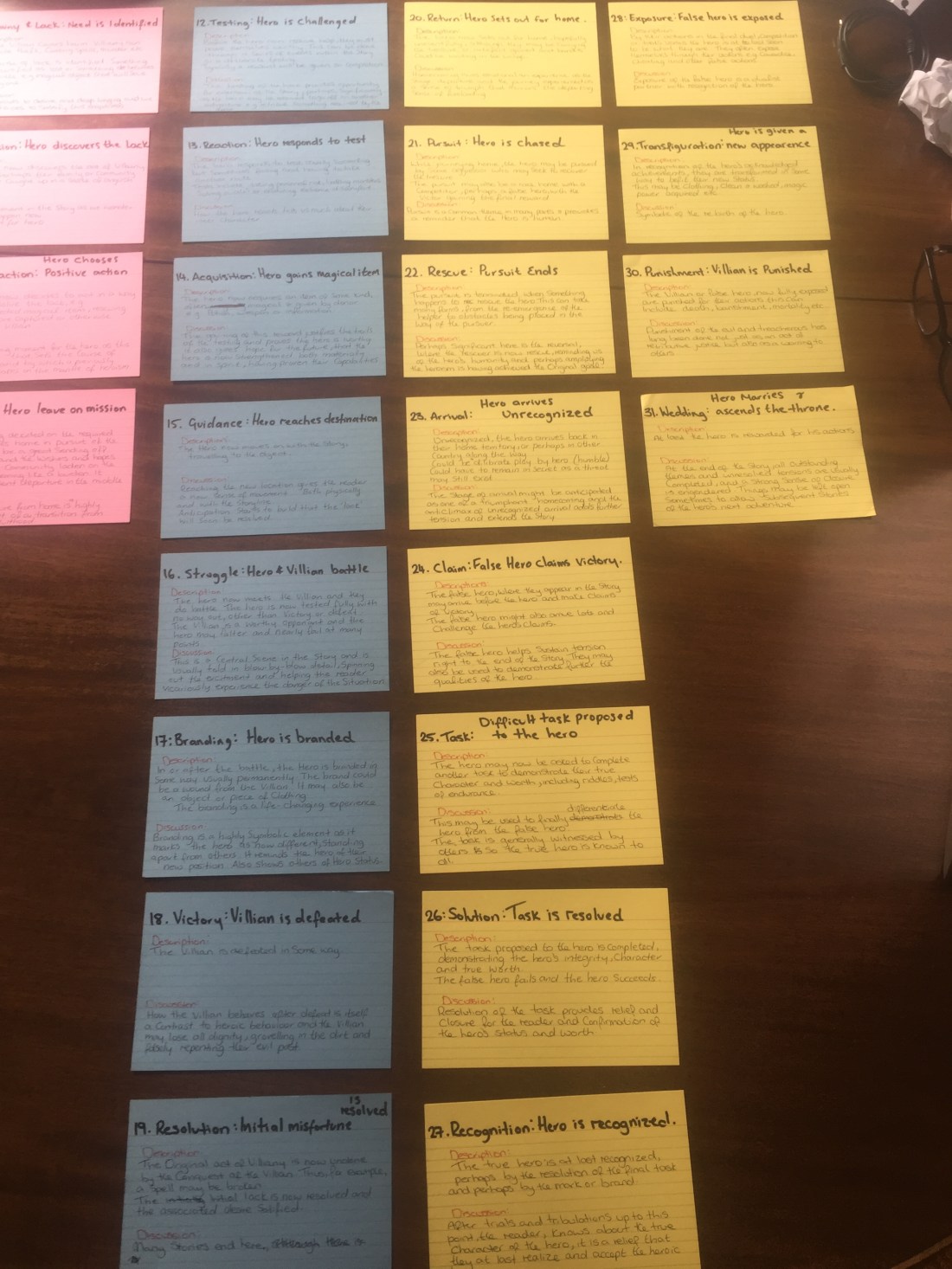
The cards in dark blue are the eight narratemes of the third sphere, the cards in yellow are the twelve narratemes of the fourth and final sphere.

The reason the cards were written and display in this way was for me to get a visual of how a story was broken up into the narratemes. These narratemes can fit quite nicely into the 3 Act structure. The first sphere acting as Act I, we’re introduced to the setting and character. The second and third sphere acting as Act II, a series of challenges and obstacles face our hero and the fourth and final sphere acting as Act III, the climax of the story and where all the loose ends are tied up.
Along with the 31 narraremes, Propp also concluded that the characters within the story could be separated into seven character functions.
- The Villian — an evil character that creates struggles for the hero.
- The Dispatcher — any character who illustrates the need for the hero’s quest and sends the hero off. This often overlaps with the princess’s father.
- The helper — a typically magical entity that comes to help the hero in their quest.
- The princess or prize, and often her father — the hero deserves her throughout the story but is unable to marry her as a consequence of some evil or injustice, perhaps the work of the villain. The hero’s journey is often ended when he marries the princess, which constitutes the villain’s defeat.
- The Donor — a character that prepares the hero or gives the hero some magical object, sometimes after testing them.
- The Hero — the character who reacts to the dispatcher and donor characters, thwarts the villain, resolves any lacking or wrong hoods and weds the princess.
- The False hero — a character who takes credit for the hero’s actions or tries to marry the princess.
These roles could sometimes be distributed among different characters for example if the hero kills the villain, a relative of the villain may take up their goal to kill the hero as revenge for the first killing.
References:
- Changingminds.org. (2018). Propp’s Morphology of the Folk Tale. [online] Available at: http://changingminds.org/disciplines/storytelling/plots/propp/propp.htm [Accessed 2 Aug. 2018].
-
Monoskop.org. (2018). [online] Available at: https://monoskop.org/images/f/f3/Propp_Vladimir_Morphology_of_the_Folktale_2nd_ed.pdf [Accessed 2 Aug. 2018].
- Propp, V., n.d. Morphology of the folktale. s.l.:Indiana University Research Center inAnthropology, Folklore, and Linguistics.[Accessed 2 Aug. 2018].
- The Narratologist. (2018). Literary Theory: Vladimir Propp’s Morphology of the Folktale. [online] Available at: http://www.thenarratologist.com/literary-theory/literary-theory-morphology-of-the-folktale-1928-by-vladimir-propp/ [Accessed 2 Aug. 2018].

 Direction concepts